Schools are often described as places where children learn, teachers teach and young people are prepared for participation in society. But schools are more than classrooms.
They are complex ecosystems. They are environments in which children, teachers, families, support staff, university and tafe students, administrators and professionals interact within layers of policies, expectations, routines, relationships and cultural assumptions.
And like every ecosystem, schools shape the people who move through them.
One of the least examined aspects of this environment is neuronormativity: the assumption that there is a normal or preferred way for brains and nervous systems to function, communicate, learn, regulate, interact and respond.
Neuronormativity does not necessarily involve deliberate discrimination. Often, it is much quieter than that.
It can appear as "common sense". It can appear as professionalism. It can appear as good behaviour. It can appear as engagement, maturity, respect, independence or readiness to learn.
And because these expectations are often invisible to the people who naturally fit them, they can become embedded throughout the school ecosystem without being recognised as expectations at all.
The question, then, is not simply whether schools accommodate neurodivergent people.
The more fundamental question is: Who was the school system designed around in the first place?
What is neuronormativity?
Neuronormativity refers to the assumption that there is a standard or preferred way for human brains and nervous systems to function.
This might include assumptions about how people should: communicate, concentrate, move, sit, make eye contact, regulate emotions, respond to authority, interact socially, transition between activities, process information, demonstrate understanding, organise themselves, respond to unexpected change.
Importantly, neuronormativity is not the same thing as saying that every neurotypical person consciously imposes expectations on everyone else. It is a systemic pattern.
A system becomes neuronormative when one way of functioning is treated as the default, while people who function differently are expected to adapt themselves to that default.
There are, however, legitimate educational and professional standards. Schools have responsibilities for safety, ethical conduct, curriculum delivery, communication and student wellbeing.
The issue is not whether standards should exist. The issue is: Which standards measure genuine competence and learnings, and which standards merely measure conformity to a particular way of being?
The school is an ecosystem
A school does not operate at one level.
There is the broader policy environment: legislation, curriculum, departmental requirements, disability frameworks, assessment systems and accountability mechanisms.
There is the organisational environment: leadership, staffing, timetables, behaviour policies, physical spaces, technology, procedures and school culture.
There is the classroom: teachers, students, learning activities, routines and relationships.
And there is the hidden curriculum: the unwritten set of lessons about how people are expected to behave.
The hidden curriculum can teach students: when it is acceptable to speak, how long they should remain still, where they should look, how they should demonstrate attention, how quickly they should respond, how emotions should appear, how they should interact with peers, how they should respond to authority, what "respect" looks like, what "good behaviour" looks like, what a "good student" looks like (and this is not an exhaustive list).
These expectations may never appear in the curriculum documents. Yet students are still assessed against them.
The construction of the "good student"
Consider the familiar image of an ideal student.
They are quiet. Attentive. Organised. Punctual. Flexible. Socially competent. Verbally responsive. Emotionally regulated. Independent. Compliant.
None of these characteristics is inherently problematic. The problem begins when these characteristics become proxies for other things.
Quiet becomes evidence of respect.
Eye contact becomes evidence of attention.
Stillness becomes evidence of engagement.
Fast responses become evidence of intelligence.
Social fluency becomes evidence of maturity or belonging.
Emotional control becomes evidence of resilience or maturity.
Independence becomes evidence of capability.
Compliance becomes evidence of motivation, especially intrinsic motivation.
A student who does not conform may therefore be judged not simply as behaving differently, but as being less capable. This is where neuronormativity becomes consequential. The system may be measuring how closely a student resembles the expected learner, rather than what that student actually knows, understands or can do.
When behaviour becomes the evidence
A student leaves the classroom. What does that behaviour mean?
They might be avoiding work. They might be overwhelmed. They might be experiencing sensory overload. They might be trying to regulate themselves. They might not understand the task. They might be communicating distress. They might be preventing an escalation.
The observable behaviour is the same. The interpretation is different. This is why context matters.
A genuinely ecological approach asks: What is happening between the person and the environment?
rather than immediately asking: What is wrong with the person?
This does not mean behaviour should never be addressed. Students have responsibilities, and teachers have responsibilities. It means that behaviour can be treated as information, rather than only as a problem to eliminate.
When behaviour is interpreted without context, schools can inadvertently punish communication they have not yet learned how to understand.
Sensory environments are not neutral
Schools often treat their physical environments as though they are neutral. They are not.
Consider: bells, fluorescent lighting, crowded corridors, assemblies, scraping chairs, constant background conversation, strong smells, unexpected touch, uniforms, announcements, unpredictable transitions, visual clutter, multiple simultaneous instructions.
For some students, these are minor inconveniences. For others, they can significantly affect their capacity to think, communicate, regulate and participate.
Yet the conventional question is often: "How can we help the student cope?"
An ecological approach asks: "What could we change about the environment?"
That is a fundamental difference. The first locates the problem primarily within the individual. The second examines the interaction between the person and their environment.
When the environment manufactures disability
This connects directly with the social model of disability. A person may be perfectly capable of learning, communicating and participating but encounter barriers because the environment has been designed around assumptions that do not fit them.
A student who can concentrate effectively in a quieter environment may be described as inattentive in a noisy classroom.
A student who understands instructions when they are written down may be described as incapable when instructions are delivered rapidly and verbally.
A student who communicates clearly through writing may be judged as having poor communication because they do not communicate fluently in spontaneous conversation.
A student who needs preparation for transitions may be described as inflexible.
In each case, the individual may be experiencing a genuine barrier. But the barrier is not necessarily located entirely within the individual. Disability can emerge through the interaction between:
person × environment × expectations × relationships × systems.
The practicum paradox
This becomes particularly interesting when we look at pre-service teachers and other students undertaking professional placement.
A practicum student occupies an unusual position. They are simultaneously: a university student, an emerging professional, a learner, a classroom participant, someone being supervised, and someone being assessed.
They have relatively little institutional power. Their supervisor often influences their assessment. The school controls the placement environment. The university controls progression through the course. And the student is expected to demonstrate "professionalism" while still learning what professionalism means.
This creates a significant vulnerability for neurodivergent students.
What does "professionalism" actually mean?
Sure. Professionalism matters. People want to be taken "seriously" and respected in their positions.
Teachers have genuine responsibilities. They need to protect students, communicate "appropriately", exercise professional judgement, maintain ethical boundaries and provide effective teaching. But professionalism can sometimes become confused with a particular social presentation of professionalism.
For example, a student teacher may be told to: appear more confident, make more eye contact, speak more spontaneously or always have "appropriate" cadence, respond more quickly, be more socially engaged, demonstrate greater flexibility, appear calmer, adjust their body language, participate more in informal staff interactions.
Some of these things may be relevant in particular contexts.
But we need to ask: Is this actually necessary for competent teaching?
Or: Is this simply how competence has traditionally been made visible?
A teacher does not necessarily need to be naturally socially effortless to be an excellent teacher. They need to be able to teach effectively. Those are not synonymous.
The confidence problem
Consider the feedback: "You need to be more confident."
What does that actually mean?
Does it mean: louder speech? more eye contact? faster responses? greater social initiation? less visible hesitation? more spontaneous interaction? more conventional body language?
A student may possess excellent pedagogical knowledge and strong relationships with students while not performing confidence in the way their supervisor expects.
Likewise: "You need to be more flexible."
can sometimes mean: "You need to tolerate unexpected changes in the way we expect you to."
But flexibility does not have to be a one-directional obligation. If classrooms contain dozens of different nervous systems, perhaps flexibility should also be a characteristic of the system.
The disclosure paradox
For a neurodivergent practicum student, disclosure can be complicated. A student may need to disclose in order to request reasonable adjustments. But they may simultaneously worry that disclosure will influence how their capability is perceived.
They may wonder:
Will they see me as less capable?
Will asking for adjustments make me appear difficult?
Will my sensory needs be interpreted as an inability to manage a classroom?
Will needing written instructions be interpreted as incompetence?
If I become overwhelmed, will that affect my assessment?
This creates a disclosure paradox.
The person may need to explain their difference in order to access support, while worrying that explaining the difference will cause others to interpret them through a deficit lens. And this is why reasonable adjustment, while essential, cannot be the only answer.
Adjustment is not the same as inclusion
Reasonable adjustments are important. They can remove barriers and enable participation. But there is a danger when adjustment becomes:
identify the different person → modify the environment slightly → return everything else to normal.
A more inclusive approach asks: Why was the environment designed this way in the first place?
Why must instructions always be verbal?
Why must engagement always look like eye contact?
Why must participation always happen through spontaneous speaking?
Why is movement interpreted as distraction?
Why is sensory regulation treated as an exception?
Why does professionalism sometimes depend on a particular social presentation?
Why does a student need to disclose a diagnosis to receive something that would make the environment more accessible to many people?
The goal should not simply be to make the individual fit the system. It should be to design systems that anticipate human variation.
The university-school divide
For students on placement, there can also be a tension between the university and the school.
Universities may explicitly teach: inclusive practice, differentiation, Universal Design for Learning, disability inclusion, strengths-based approaches, culturally responsive practice, student voice.
Yet a student may enter a placement environment in which the hidden curriculum communicates something different: "This is how we do things here."
That creates an uncomfortable contradiction. The student is being taught to adapt learning environments for diverse children while simultaneously being expected to adapt themselves to an established professional environment.
The message can become: Accommodate difference in your students, but don't let too much difference become visible in yourself.
That deserves scrutiny.
Who gets to define competence?
This may be one of the most important questions in the entire discussion.
A student teacher may be highly competent but struggle with: rapid verbal processing, sensory overload, unstructured social interaction, executive functioning, conventional body language, constant context-switching.
Another student may appear effortlessly confident, socially fluent and flexible while struggling significantly with curriculum planning, pedagogy or classroom management.
If assessment disproportionately rewards the first set of characteristics, it can confuse presentation with competence.
This matters far beyond neurodivergent students.
It raises a broader question about professional education: Are we assessing what someone can actually do, or how convincingly they can perform the expected identity of a professional?
The double empathy problem
There can also be a mismatch between how a neurodivergent student and a neurotypical supervisor interpret the same interaction.
A supervisor may see limited eye contact and interpret disengagement. The student may be concentrating intensely.
A supervisor may see hesitation and interpret uncertainty. The student may be processing information carefully.
A supervisor may see movement or toilet breaks and interpret distraction. The student may be regulating their nervous system or dealing with chronic illness.
A supervisor may see a preference for written communication and interpret poor interpersonal skills. The student may communicate exceptionally well through writing.
Neither party necessarily intends harm. The difficulty is that each person may be interpreting the other through their own expectations.
This is sometimes described through the concept of the double empathy problem: differences in communication and experience can create misunderstandings between people with different neurotypes.
The solution cannot always be "teach the neurodivergent person to communicate normally." Sometimes the other person needs to learn how to interpret differently too.
Who gets to explain the student?
There is another important question here: Who gets to decide what a student's behaviour means?
The teacher? The psychologist? The behaviour specialist? The parent? The university assessor? The placement supervisor? Or the student themselves?
Students are often discussed extensively by adults while having surprisingly little authority over the interpretation of their own experiences. A genuinely inclusive ecosystem takes lived experience seriously.
That does not mean accepting every interpretation uncritically. It means recognising that the person experiencing the environment possesses information that cannot necessarily be observed from outside.
There is an epistemic dimension to inclusion: Who is considered credible when they explain what they need?
Representation matters
The consequences extend beyond individual placements.
If neurodivergent students repeatedly encounter environments that communicate: "You don't quite fit here," some may leave the profession.
That matters. Just look at the current statistics within the education industry.
If neurodivergent educators are systematically pushed out of education, schools lose teachers who may bring valuable knowledge, perspectives and lived experience to neurodivergent students.
This can create a cycle: institutional conformity → reduced diversity among educators → reduced representation → continued normative practice.
Representation alone will not solve systemic exclusion. But neither can systems become meaningfully inclusive if the people designing and delivering those systems are expected to conceal or suppress significant parts of themselves in order to belong.
Intersectionality matters too
Neuronormativity does not operate in isolation. Expectations about communication, confidence, respect, behaviour and professionalism can intersect with: disability, gender, culture, health, language, socioeconomic circumstances, trauma, age, physical disability, other forms of difference.
Who is considered "confident"? Who is considered "aggressive"? Who is considered "professional"? Who is considered "difficult"? Who is considered "mature"?
These judgments are not always neutral. A particular communication style may be interpreted differently depending on who is using it. This makes the idea of a single, objective model of "professional behaviour" much more complicated than it first appears.
Inclusion theatre
Schools can become very good at the language of inclusion. They may have: inclusion policies, wellbeing programs, sensory spaces, individual learning plans, behaviour frameworks, disability adjustments, professional development, student support teams.
These can all be valuable. But inclusion cannot be measured solely by whether these structures exist.
A more difficult question is: Who had to change in order for inclusion to happen?
If every adjustment ultimately requires the neurodivergent person to become quieter, more flexible, more regulated, more socially conventional and more compliant, then the system itself may not have changed very much. It may simply have become better at accommodating difference conditionally.
There is a difference between: "You can participate if we can make you fit."
and: "We designed participation with human variation in mind."
From individual accommodation to systemic design
Universal Design for Learning and broader principles of universal design can offer a useful alternative. Rather than beginning with the assumption that there is one correct way to learn, communicate or participate, we can design environments that anticipate variation.
This might include: multiple ways of communicating, explicit rather than implied expectations, clear written instructions, predictable routines with room for flexibility, meaningful transition preparation, movement opportunities, sensory-aware environments, multiple ways of demonstrating learning, flexible participation methods, reduced reliance on eye contact as evidence of engagement, accessible communication practices, psychologically safe disclosure, meaningful reasonable adjustments.
Importantly, these approaches do not only benefit neurodivergent people.
Clear instructions help many people.
Predictable routines help many people.
Flexible communication helps many people.
Multiple ways of demonstrating understanding help many people.
Sensory-aware environments help many people.
What is sometimes described as a "special accommodation" is often simply good design.
What can schools and universities do differently?
Schools, universities and placement providers can begin by asking different questions.
Instead of: "How do we make this student fit our environment?"
Ask: "What barriers does our environment create?"
Instead of: "Why won't this student behave appropriately?"
Ask: "What is this behaviour communicating, and what is happening around the student?"
Instead of: "Does this student look confident?"
Ask: "Can this student perform the professional task effectively?"
Instead of: "Does this student communicate like we expect?"
Ask: "Can this student communicate effectively, and are we allowing more than one legitimate communication style?"
Instead of: "Does this student cope with change?"
Ask: "How much flexibility is built into our system?"
Instead of: "What adjustment does this person need?"
Ask: "What could we design differently so fewer people encounter this barrier in the first place?"
These questions shift the focus from fixing people to examining systems.
What should practicum assessment actually measure?
This is particularly important for universities and placement providers.
Professional standards are necessary. But assessment should distinguish between: competence and performance of normativity.
A teacher may need to communicate effectively. That does not necessarily require constant eye contact.
A teacher may need to manage a classroom. That does not necessarily require suppressing every natural movement or bodily function.
A teacher may need to respond to unexpected situations. That does not necessarily mean being spontaneously comfortable with every change.
A teacher may need professional relationships. That does not require one particular social style.
The question should always return to: What is the actual professional outcome we need, and what assumptions have we attached to the way that outcome must look?
That distinction can make assessment more valid, not less rigorous.
The deeper question: who gets to define "normal"?
Ultimately, the issue is bigger than autism or ADHD. It is about how institutions construct normality.
Schools teach mathematics, literacy, science, history and other formal curriculum. But they also teach: how bodies should behave, how emotions should appear,
how communication should sound, how quickly people should respond, how authority should be respected, how productivity should look, and what participation is supposed to look like.
That is the hidden curriculum.
And for people who do not naturally fit its assumptions, the hidden curriculum can become an additional disability barrier.
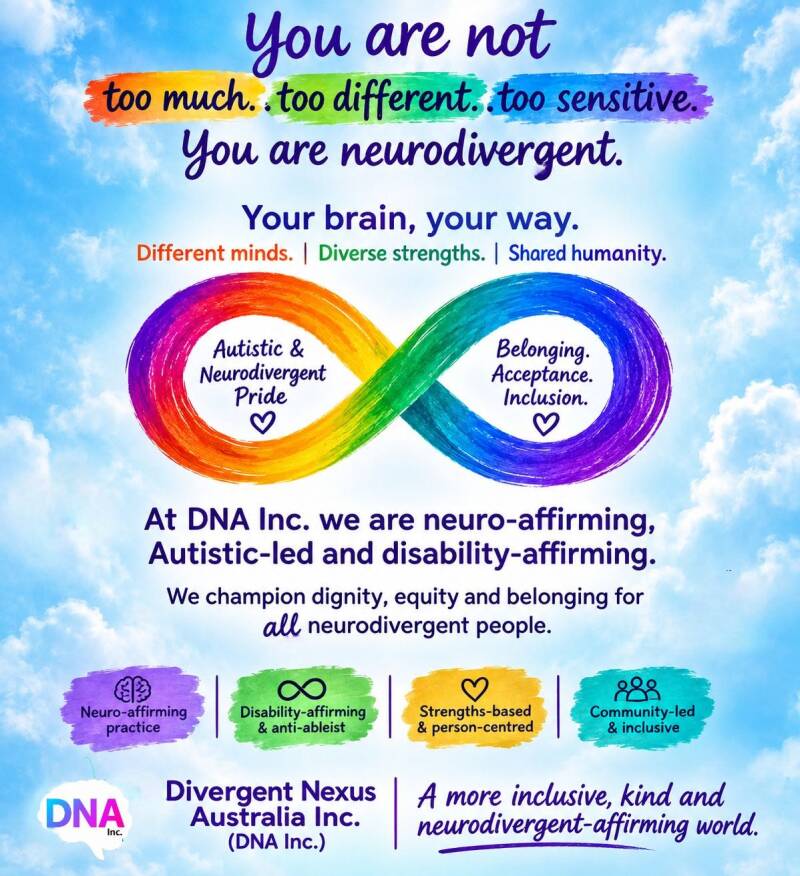
A DNA Inc. perspective
At DNA Inc., we believe inclusion should not require people to become less visibly themselves in order to be recognised as capable.
That does not mean removing expectations. It means interrogating them.
It means asking whether a requirement is genuinely necessary, or whether it reflects a historical preference that has been mistaken for a universal standard.
It means recognising that different nervous systems may communicate, regulate, learn and participate differently without those differences representing deficits.
It means taking lived experience seriously.
It means moving beyond the idea that the individual is always the thing that needs to change.
And it means recognising that the environment is part of the equation.
Because:
Competence is not eye contact.
Engagement is not stillness.
Respect is not compliance.
Communication is not one particular communication style.
Regulation is not the absence of visible distress.
Flexibility is not the ability to tolerate every environment without support.
Professionalism is not the performance of neurotypicality.
A student who needs to move is not necessarily disengaged.
A student who avoids eye contact is not necessarily disrespectful.
A student who needs explicit instructions is not necessarily incapable.
A student who becomes overwhelmed is not necessarily difficult.
A student teacher who communicates differently is not necessarily less professional.
Sometimes the person is not failing the environment.
The environment is failing to recognise the person.
And perhaps that is where genuine inclusion begins.
Not with asking: "How do we make different people fit the system?"
But with asking: "What would our schools look like if human neurological variation was treated as an ordinary part of being human from the beginning?"
That is not a lowering of standards. It is a challenge to make sure our standards are actually measuring what we say they measure. And that is a challenge worth taking seriously.